
Frog Jump works on one tense loop: you commit a stake, hop a frog up a stack of platforms to build a multiplier, and cash out before a missed jump crashes the round to zero. A crash game, in casino terms, is an instant-win title where a multiplier climbs and you choose when to bank it, and Frog Jump is InOut Games’ skill-based take on that format. According to InOut’s own game page it runs a 95.5% return-to-player with a 25,000x maximum win, and it was released on 23 June 2026. This review explains the mechanic itself, the model behind the buttons, so the numbers on screen actually mean something. For the controls see our how-to-play guide; for what each platform pays, the platform values page.
It is a crash game, not a slot
Frog Jump has no reels, no paylines and no spinning symbols, and clearing that up first matters because the search results are cluttered with look-alikes. The game is an instant-win crash title in the family of Aviator and InOut’s own Chicken Road, where a multiplier builds and you decide when to bank. The twist is that you’re not watching a rocket climb on its own; you’re steering a frog, so the climb is a skill input rather than a passive wait. Here are the fast facts that define the format.
- Frog Jump is a skill-crash game released by InOut Games on 23 June 2026.
- The game has a 95.5% return-to-player, according to InOut’s published spec.
- The maximum win is 25,000x your stake, roughly 2.5 times the 10,000x ceiling common on rival crash games.
- The round crashes to zero the moment a jump is missed, so a healthy-looking multiplier can vanish instantly.
- InOut Games, whose founder built the studio in 2024, backs the game with 1 million in demo credits for free practice.
The round, step by step
Every round runs the same shape, and watching it once makes the whole game click. The multiplier is the figure your stake is multiplied by when you cash out, and it opens at 1.00x on every round.
For example, when I pressed Play on a $5 stake in our demo session on 21 July 2026, the balance dropped to $999,995 before the frog even moved, which tells you the stake is committed up front. From there the frog sits at the base of a vertical stack of stones, logs, lily pads and, higher up, flowers. You choose the direction of each hop. Land it, and that platform’s value is added to your running multiplier, which pushes the Cash Out figure up in real time. Choose to bank, and the round ends in your favour at whatever the multiplier reads. Miss the jump, and the round crashes to zero and takes the stake with it. So a live round is really a rolling series of small bets, and every hop asks the same question: again, or bank?
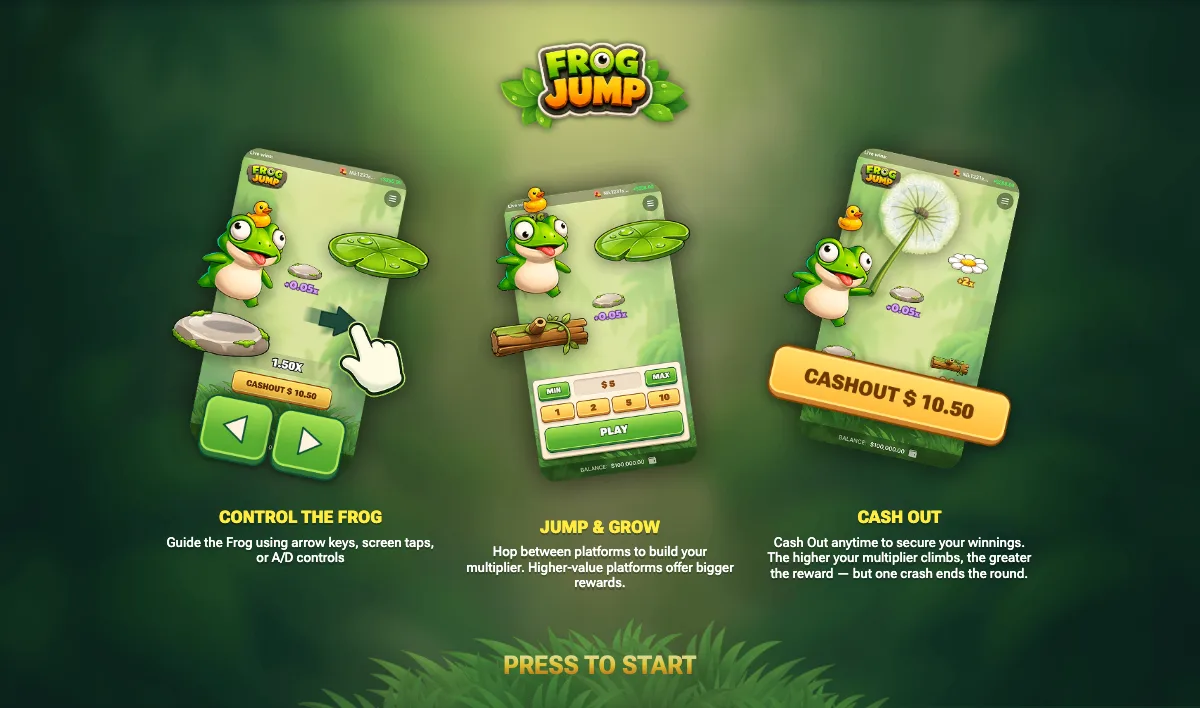
What decides whether a jump lands?
The outcome of each jump is an RNG result inside the published 95.5% return, and honestly this is where reviews should stop pretending they know more than they do. InOut doesn’t publish the crash curve, so I can’t tell you the exact probability of any single jump landing, and anyone quoting precise odds is guessing. What I can say from testing is that the gaps between platforms and their values are visibly linked. The cheap stones sit close and feel forgiving; the high-value flowers sit further out and miss more often. Risk and reward are wired together, which is the design working as intended rather than a flaw.
Manual cash-out is the whole point
Cash Out sits on screen the entire round, and that single design choice is what separates Frog Jump from a lot of the genre. The exit is fully manual and always available. There’s no auto-resolve deciding your fate, and crucially there’s no auto-stop protecting you from yourself. That cuts both ways, and I’ll come back to the downside, but the upside is real: a good run is genuinely yours to bank, and the decision feels like skill rather than luck alone.
Where the mechanic frustrates
No mechanic is flawless, and this one has two rough edges I felt keenly. Because there’s no safety net, a lapse in judgment is punished immediately and completely. I was surprised by how fast a strong round could evaporate; I zeroed several by reaching one platform too far, and the game does nothing to soften that, which is frustrating in the moment. The second edge is technical: the controls are a DOM overlay while the scene is canvas, so on a laggy connection the hop input can feel sluggish and a beat behind the animation, and on a timing-based game that’s more than cosmetic. Neither is a dealbreaker, but both shape how the round feels in the hand.
How we confirmed this
Reviewer Ryan Cole played the official InOut demo hands-on on 21 July 2026, staking 5 dollars a round, per our standard routine. I watched the balance deduct on launch, tracked the multiplier as it built, and forced a few crashes deliberately to confirm the round pays zero on a miss. The 1 million in demo credits made it cheap to run the loop dozens of times. Every headline figure was cross-checked against InOut’s own page, and where the studio keeps a detail private, such as the crash odds, I’ve flagged it rather than inventing one. Full approach on our methodology page.
Sources
- the official InOut Games Frog Jump page, for the 95.5% RTP, the 25,000x max win and the release date
- the InOut Games studio site, for its crash-game portfolio and 2024 founding
Published 21 July 2026. Updated 21 July 2026. Tested by Ryan Cole.
Does the round auto-resolve, or do I cash out myself?
You cash out yourself. Cash Out is on screen the whole round, and there is no auto-stop. Miss a jump before you press it and the round pays zero, so the timing of your exit is entirely your decision.
Is Frog Jump a slot machine?
No. Frog Jump has no reels or paylines. It is a skill-crash / instant-win game where you steer a frog up platforms and bank a rising multiplier, closer to Aviator than to a video slot.
Can I predict when the round will crash?
No. Each jump is an RNG outcome inside the 95.5% RTP, and InOut does not publish the crash-probability curve. Higher, further platforms simply miss more often than the close, cheap ones.