
Five dollars vanished from my demo balance the instant I pressed Play. The counter dropped from $1,000,000 to $999,995, a green frog crouched on a lily pad, and a single multiplier read 1.00X. That is Frog Jump in one breath: you commit the stake first, then you climb, and the only question that matters is when to hit Cash Out before a missed hop wipes the round to nothing. InOut Games released it on 23 June 2026 with a published 95.5% RTP, high volatility, and a 25,000x maximum win. After a couple of hours in the official demo, here is where I landed: it is one of the more genuinely tense crash titles I have played this year, and also one of the easier ones to lose your discipline on.
This is the deep-dive review. If you just want to play, the free demo is embedded on our home page and broken down on the demo guide. Here I am covering how the game actually behaves over a long session, what the numbers mean for your bankroll, and whether it is worth real money.
The verdict, up front
I scored Frog Jump 7.6 out of 10. It earns that on nerve and clarity. Most crash games ask you to watch a rocket and guess; Frog Jump makes you do something every second the round is live, and the decision to cash out feels like yours rather than the game’s. The 95.5% RTP is fair, the 25,000x ceiling is genuinely large for the genre, and the free demo lets you rehearse before a cent is on the line.
What keeps it off an 8 or 9 is the thin published spec and the punishing variance. InOut confirms the RTP, the max win and the release date on its own game page, but the exact bet floor, the full platform table and the crash odds are not published anywhere I could verify, so parts of any review, including this one, lean on affiliate listings and hands-on observation rather than the studio’s word.
How a round plays out
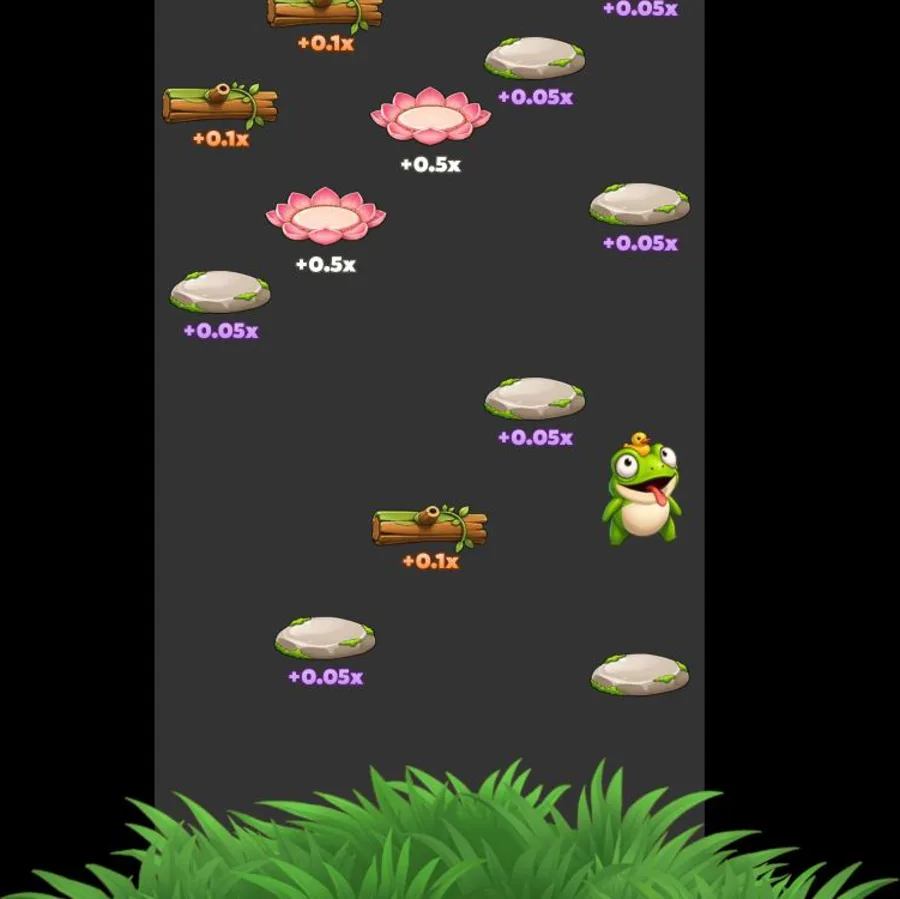
You set a stake, press Play, and a cartoon frog with a duckling on its head sits at the bottom of a vertical stack of platforms. From there you steer its next hop with the arrow keys, the A and D keys, or a tap on either side of the screen. Land safely and that platform’s value is added to a running multiplier. Miss, and the round is over.
The platforms are colour-coded by value, and learning to read them fast is the whole skill. A grey stone nudges the multiplier by +0.05x. A brown log adds +0.1x. A green lily pad is worth a full +1x, and the flowers higher up the stack, a dandelion and a white daisy, pay more still. The platform values guide lays out the full ladder. Cash Out sits on screen the entire time, showing exactly what you would bank if you stopped now.
Here is the part that surprised me. Because you control the frog, a bad round is often your own fault, not the RNG’s. I lost three rounds in a row early on by getting greedy above 4x and fumbling the jump to a daisy that was one column too far. That stings in a way a pure auto-crash game never does, and it is also, weirdly, the appeal.
What the 95.5% RTP means for your money
Return to player of 95.5% means that, averaged over a very large number of rounds, the game pays back $95.50 for every $100 staked. It is InOut’s own published figure. You will see 97% quoted on a few aggregator pages; that number belongs to a different frog-themed game and does not apply here, so I would ignore it. Compared to the field, 95.5% is a touch below Aviator’s 97% and a shade under InOut’s own Chicken Road, but comfortably ahead of the many sub-95% slots that fill casino lobbies.
The volatility is the bigger story. InOut labels the game high-volatility, and my sessions bore that out hard. The frog splashed on the second or third platform far more often than felt fair, then one round in maybe forty ran long enough to make the ledger look healthy again. The RTP and volatility page goes deeper into what that swing does to a fixed bankroll. The short version: budget for cold streaks, because they are the default, not the exception.
Deposits, withdrawals and where you actually play
Frog Jump is a game, not a casino, so payments depend entirely on the operator you sign up with, not on InOut. In practice the casinos that carry InOut titles tend to support the usual mix: Visa and Mastercard, e-wallets such as Skrill and Neteller, and crypto like BTC or USDT. Card and e-wallet deposits are typically instant; withdrawals vary from a few minutes on crypto to a few working days on cards, and every operator sets its own limits and KYC checks.
I would not pick a casino on the game alone. Check the licence, the withdrawal cap and the payout reputation first, then confirm it runs the genuine InOut build of Frog Jump rather than a look-alike. Our is-it-legit page covers the licensing side.
Where Frog Jump falls short
No review is honest without the downsides, and this one has real ones.
The variance is brutal if you are not ready for it. During one twenty-minute stretch I did not clear 2x a single time, and a flat-staking player would have bled steadily. There is no auto-stop, no safety net; the discipline is entirely on you, which is great until you are tired and chasing.
The published spec is genuinely thin. I could confirm the RTP, the 25,000x ceiling and the release date from InOut, but the exact minimum and maximum bet, the full platform-value table and the crash probabilities are not documented by the studio, so anyone who tells you the precise odds is guessing. The licensing is Curacao eGaming plus Anjouan, which is lighter-touch than a UK or Malta licence and worth knowing before you deposit. And that 25,000x headline? I never came close. It is a rare-tail lottery climb, not a realistic target, and treating it as one is the fastest way to lose.
How I tested it
Everything above comes from playing the official InOut demo hands-on on 21 July 2026, funded with the $1,000,000 in play credits the demo starts you with. I logged what each platform added to the multiplier, tracked how often rounds ended early, and cross-checked every headline number against InOut’s own game page. Where the studio has not published something, I have said so rather than filling the gap with a confident-sounding guess. You can read more about how I work on the methodology page.
Sources
- the official InOut Games Frog Jump page for the 95.5% RTP, the 25,000x max win and the 23 June 2026 release date
- the InOut Games company site for the studio background and Curacao and Anjouan licensing
- SlotCatalog’s Frog Jump listing, used to cross-check the platform values and separate this game from KA Gaming’s unrelated “Jumping Frog”
Published 21 July 2026. Updated 21 July 2026. Reviewed by Ryan Cole.
Is Frog Jump worth playing for real money?
If you enjoy a decision-based crash game and you treat the 25,000x as a long shot rather than a plan, yes. The 95.5% RTP is fair and the cash-out control genuinely rewards discipline. If you want steady, low-variance play, its high volatility will grind on you, so demo it first.
Does skill actually change the outcome?
Partly. You cannot beat the RNG, and the platform each jump offers is random, but the timing of your Cash Out is a real decision that shapes your return. In my sessions the disciplined choice was almost always to bank early rather than reach for the top platform.
What is the difference between this and KA Gaming’s Jumping Frog?
They are different games from different studios. Frog Jump is a 2026 skill-crash title by InOut Games with a manual cash-out; “Jumping Frog” is a conventional reel slot by KA Gaming. Any 97% RTP or reel-and-payline description you see almost certainly belongs to another frog game, not this one.